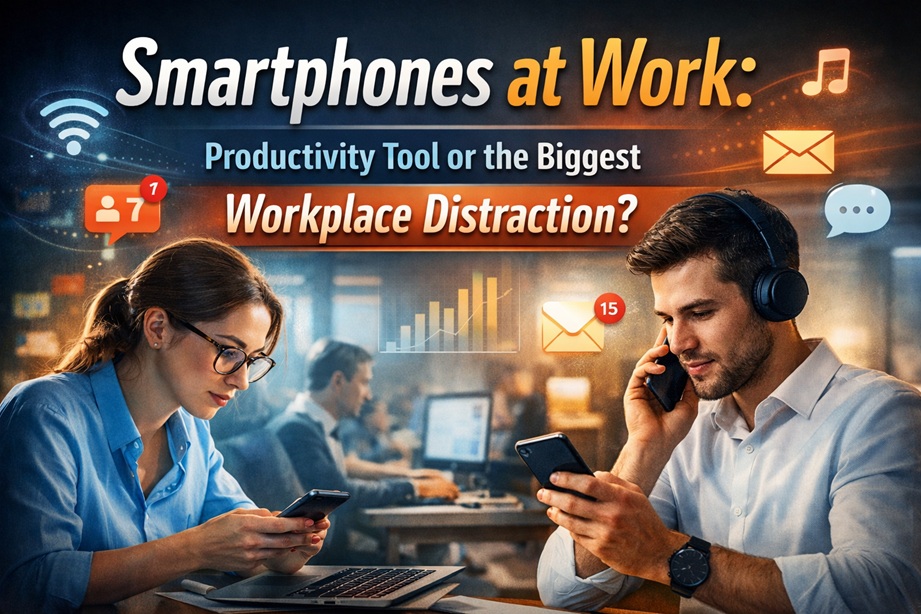
Walk into almost any office today and you will notice a common scene: employees working with one eye on their computer and the other on their smartphone. Messages, social media, podcasts, and notifications constantly compete for attention. The question organisations must now confront is simple but critical: are smartphones empowering productivity—or quietly eroding it?
The Attention Economy in the Workplace
Across offices, laboratories, factories, and service environments worldwide, a growing concern is emerging among managers and organisational leaders: the increasing presence of smartphones during working hours.
Employees frequently check messages, scroll social media, browse the internet, or listen to podcasts and music while performing their tasks. In some workplaces it has become common to see employees working with headphones on, their attention split between their work and their devices.
This raises an important question for organisations across the globe: Should smartphone use be restricted during working hours to protect productivity and efficiency? The answer is not straightforward.
The Global Smartphone Reality
Smartphones have become an integral part of modern professional life. Research suggests that:
- Employees check their smartphones around 150 times per day on average.
- Digital distractions can result in two to three hours of lost productive time daily.
- Frequent digital interruptions may reduce productivity by up to 40% in knowledge-based roles.
At the same time, smartphones are increasingly used as professional tools. Many employees rely on their mobile devices for work-related tasks such as:
- Email communication
- Collaboration platforms (Teams, Slack, Zoom)
- Calendar and scheduling
- Project management applications
- Remote access to documents and systems
Studies suggest that around 60% of smartphone usage at work is related to professional activities.
This creates what many experts describe as the productivity paradox: smartphones simultaneously enhance efficiency and reduce focus.

The Cost of Distraction
One of the most significant impacts of smartphone use is interruption and context switching.
When employees check notifications, messages, or social media, their cognitive attention shifts away from the primary task. Research in cognitive psychology suggests that it can take more than 20 minutes to regain full focus after an interruption.
Even brief phone interactions can lead to what researchers call “attention residue”, where part of the brain remains mentally engaged with the previous distraction. The cumulative effect is not just seconds lost checking a notification, but significant reductions in deep concentration and work quality.
Generational Change and Digital Behaviour
The smartphone debate is also influenced by generational shifts within the workforce. Younger generations have grown up in a digital-first environment where smartphones are central to communication, learning, and information access.
For example:
- Nearly 98% of Generation Z own smartphones.
- Millennials and Gen Z spend significantly more time interacting with mobile technology than previous generations.
- Many younger professionals prefer mobile-based communication and learning platforms.
By contrast, older generations often prefer face-to-face communication and structured channels such as meetings or email. However, as Millennials and Gen Z now represent the majority of the global workforce, expectations around technology use at work are evolving rapidly.

While smartphones support work communication, a significant portion of workplace phone usage remains personal.
Cultural Perspectives: Insights from Hofstede
Smartphone behaviour in the workplace is not only generational—it is also cultural. The cultural research of Geert Hofstede helps explain why attitudes toward workplace technology vary across countries.
For example:
Individualistic cultures (such as the UK, United States, and Northern Europe) place high value on personal autonomy, meaning employees may resist strict behavioural restrictions such as smartphone bans.
Collectivist cultures, particularly in parts of Asia, often place stronger emphasis on group discipline and organisational harmony, making structured workplace rules more widely accepted.
Similarly, societies with low power distance where employees expect equality between management and staff, may perceive strict device policies as overly controlling. These cultural factors explain why the debate around smartphone use at work can look very different depending on the organisational and national context.
Should Smartphones Be Banned?
Some organisations have experimented with strict policies such as:
- Collecting phones during working hours
- Introducing phone lockers
- Creating “device-free” work zones
- Limiting phone access to break periods
Such policies can offer several advantages:
✔ Improved focus and concentration
✔ Reduced distractions
✔ Better customer-facing professionalism
✔ Improved safety in operational environments
However, banning smartphones entirely can also create challenges:
✖ Employee dissatisfaction
✖ Perceived lack of trust
✖ Reduced flexibility in communication
✖ Practical challenges for roles that rely on mobile technology
The Balanced Approach: Digital Etiquette Policies
Rather than banning smartphones outright, many organisations are adopting balanced smartphone usage policies. These policies aim to create clear expectations while recognising the benefits of mobile technology.
Typical guidelines include:
- Phones should not be used during meetings unless work-related.
- Devices should remain on silent mode in shared workspaces.
- Phone use should be avoided in customer-facing or safety-critical environments.
- Reasonable personal use may be allowed during breaks.
- Teams should encourage periods of uninterrupted focus.
The goal is not to eliminate technology but to promote professional and responsible usage.
Managing Attention in the Digital Age
Ultimately, the smartphone debate reflects a deeper challenge within modern organisations: the management of attention. Technology has dramatically increased the number of stimuli competing for employees’ focus. Successful organisations are therefore not those that simply prohibit devices, but those that build cultures of accountability, focus, and digital discipline.
In an era where attention is one of the most valuable organisational resources, managing digital behaviour may become one of the defining leadership challenges of the modern workplace. The real challenge facing organisations today is not whether smartphones belong at work—but whether workplaces can learn to manage attention in an age designed to constantly disrupt it.